
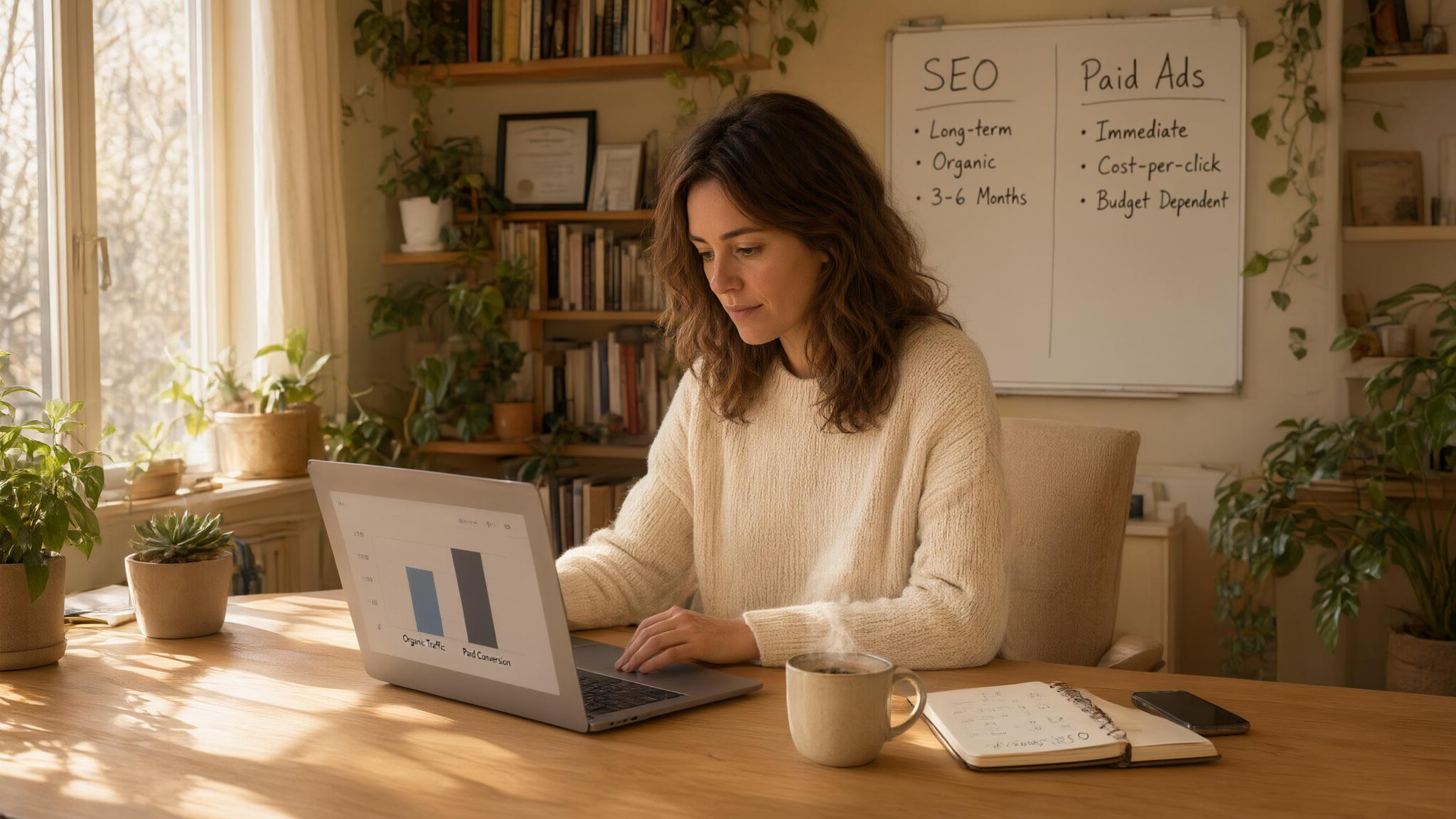
If you’re trying to figure out SEO vs paid ads for small business, let me save you the endless Googling: there is no single right answer, but there is almost always a smarter choice for your specific situation — and most small business owners are getting it wrong.
I’ve consulted with dozens of entrepreneurs over the years, and the same pattern keeps showing up. Someone blows their first €500 on Google Ads, gets a trickle of clicks that go nowhere, and then swears off paid traffic forever. Or they invest six months into SEO, see zero movement, and panic-spend on ads to compensate. Both scenarios are painful, and both are avoidable.
My honest take? For most bootstrapped small businesses, SEO is the smarter long-term foundation — but dismissing paid ads entirely is a mistake too. The real question isn’t which is better in theory. It’s which one fits where your business is right now. In this post, I’m breaking down the actual tradeoffs so you can make a decision based on your budget, timeline, and goals — not someone else’s marketing playbook.
What You’re Actually Paying For: SEO vs PPC Costs Explained

Let me be blunt about something most marketing blogs gloss over: the cost comparison between SEO vs paid ads for small business isn’t just about your monthly invoice. It’s about what you’re actually getting in return for that money, and how long it lasts. With Google Ads or any PPC campaign, you’re essentially renting visibility. The moment your budget runs dry, your traffic disappears. Poof. Gone. I’ve watched small business owners pour thousands into ad spend every month, see decent results, then hit a rough quarter, pause the campaign, and lose everything they “built.” You didn’t build anything. You were leasing it.
SEO works differently, and honestly, that’s what makes long term SEO so compelling for businesses that can’t afford to bleed cash indefinitely. Yes, you’re paying upfront — whether that’s your own time, a freelancer, or an agency — but the results compound. A well-optimized page I wrote for a client two years ago still drives leads today without an extra cent spent on it. That’s not magic, that’s equity. With organic vs paid traffic, the organic side keeps working in the background while you sleep. Paid stops the second you stop paying. When you frame it that way, the “cheaper” option isn’t always the one with the lower monthly price tag.
That said, I’m not here to pretend SEO is free or fast. It takes real investment upfront — sometimes six to twelve months before you see meaningful traction — and that timeline is a genuine problem if your cash flow is tight right now. PPC can get you in front of customers next Tuesday, and there’s real value in that. The honest answer when comparing seo vs ppc is that they serve different financial situations. If you have runway and patience, SEO builds an asset. If you need immediate pipeline and have ad budget to test, paid can bridge the gap. What I push back on is the idea that you should default to ads forever because SEO “takes too long.” That patience gap has a real cost too — you’re just paying it in perpetuity instead of upfront.
Organic vs Paid Traffic: The Timeline Nobody Warns You About

Here’s the thing nobody sits you down and explains when you’re weighing up SEO vs paid ads for small business: the timelines are completely different animals, and confusing them is one of the most expensive mistakes I see small business owners make. When you launch a Google Ads campaign, you can be on page one by this afternoon. That’s real, and it’s genuinely useful when you need leads now. But the moment you stop paying, you vanish. Completely. It’s like renting a billboard — the second the cheque stops, the sign comes down. I’ve had clients who built their entire customer pipeline around paid traffic, then had a rough quarter, paused their ads budget out of necessity, and watched their enquiries drop to almost zero within days. That’s a fragile place to run a business from.
Organic traffic through long term SEO works on the opposite logic entirely. For the first three to six months, honestly, it can feel like you’re shouting into a void. You’re writing content, building links, fixing technical issues, and your analytics look depressingly flat. I won’t sugarcoat that part — it tests your patience. But somewhere around month four or five, something shifts. Pages start climbing. You start appearing for searches you didn’t even specifically target. And here’s what makes it fundamentally different from the organic vs paid traffic comparison: that momentum compounds. A piece of content I helped a client publish eighteen months ago still brings in qualified leads every single week without any additional spend. That doesn’t happen with ads.
So when people ask me about SEO vs PPC as if it’s a straight either/or choice, I always push back a little. The real question is about your business’s current situation. If you have zero cash flow and need revenue in the next thirty days, SEO cannot save you right now — that’s just honesty. But if you have even a modest runway and you’re thinking about where you want to be in eighteen months, putting nothing into organic search is leaving future customers on the table for your competitors to pick up instead.
When to Choose SEO, When to Run Ads — and When to Do Both

Here’s the honest answer I give every small business owner who asks me about SEO vs paid ads for small business: it depends entirely on where you are right now, not where you want to be. If you opened your doors last month and you need customers this week, SEO is not going to save you. I say that as someone who genuinely loves organic search. The truth is that long term SEO is a compounding investment — it builds slowly, then pays you back for years. But if your cash flow is tight and you’re waiting on Google to notice you exist, that’s a rough place to be. In that situation, a tightly controlled paid campaign with a small daily budget can get you in front of real buyers while your organic foundation is still being built. That’s not a betrayal of SEO philosophy, that’s just being practical about how businesses actually survive.
On the flip side, I’ve watched business owners dump serious money into Google Ads month after month because they were too impatient to invest in organic vs paid traffic from a long-game perspective. The moment they paused the ads, everything went silent. No residual visibility, no content working for them overnight, nothing. That’s the trap. Paid traffic is rented traffic — the second you stop paying, it disappears. So if you’ve been running ads for more than six months and haven’t used any of that time to build out your SEO foundation, you’re essentially starting from zero every single billing cycle. I’ve seen this burn out small business owners who had genuinely good products and services. It’s not a sustainable model on its own.
The sweet spot, in my experience, is a sequenced approach. Use ads to generate immediate revenue and learn which messaging actually converts your specific audience. Then take those insights and build them into your SEO content strategy so your organic presence eventually carries the weight. This is where SEO vs PPC stops being a competition and starts being a conversation. For most small businesses I work with, that’s the frame that finally makes everything click.
Final Thoughts
The best marketing strategy isn’t the one that sounds most impressive — it’s the one you can actually sustain. I’ve worked with small business owners who burned through their budgets on paid ads chasing quick wins, and others who quietly built organic traffic that still pays off years later. Neither path is universally right. What matters is knowing where you stand right now — your budget, your timeline, and how much uncertainty you can handle. For most small businesses, I lean toward starting with SEO as your foundation and layering in paid ads once you have something solid to build on.
The SEO vs paid ads debate for small business really comes down to one honest question: what can you commit to consistently? Because half-hearted efforts in either channel will cost you more than a clear, focused decision ever will. Figure out what fits your reality, start there, and adjust as you grow.
What’s your take on this? I’d love to hear it. 👇