
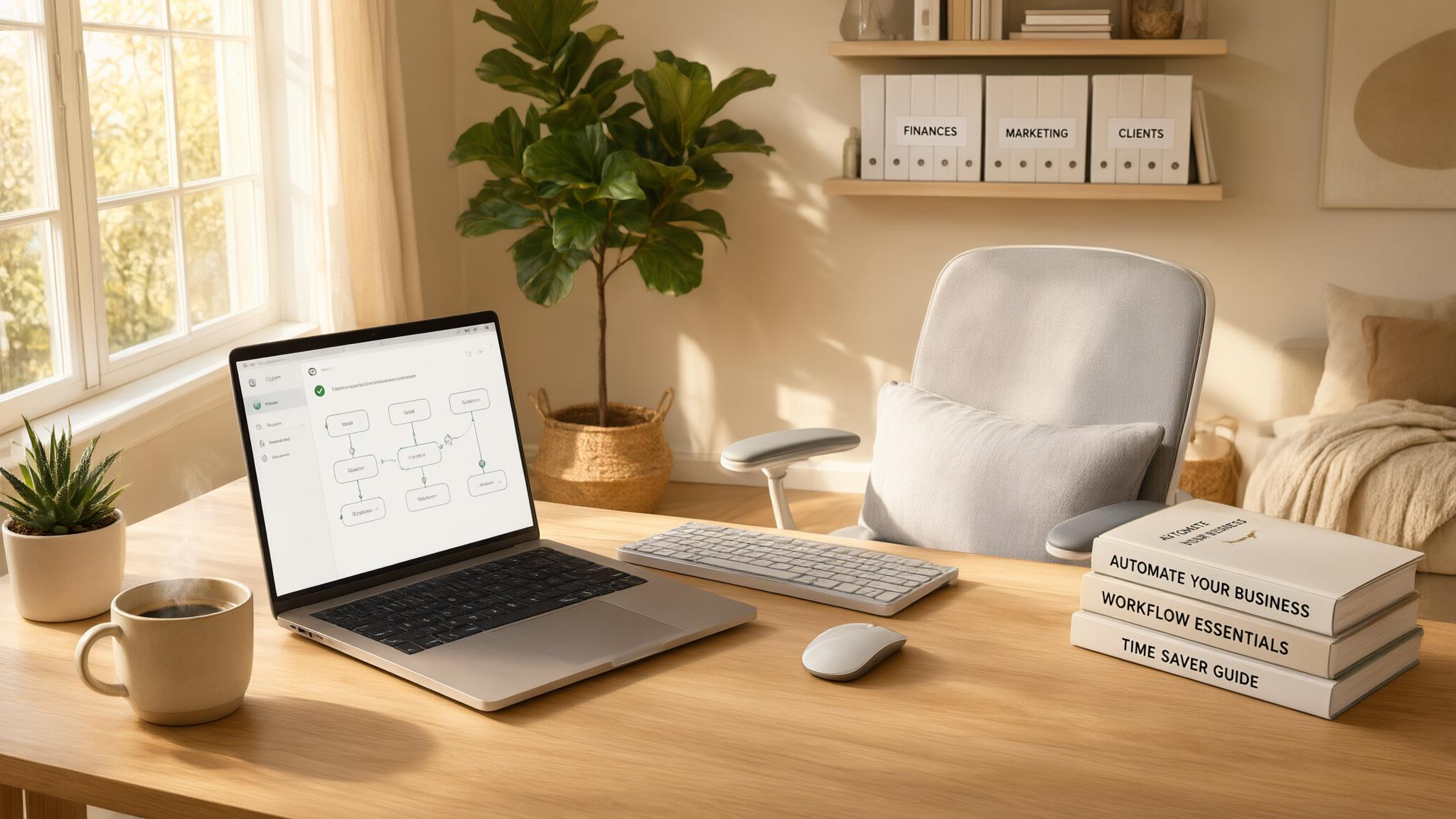
If you want to know how to automate your online business, my honest advice is this: start before you think you’re ready, not after you’re drowning in repetitive tasks at 11pm on a Thursday.
I made the classic mistake. I told myself I’d set up automation “once things picked up.” What actually happened is that things picked up, I had zero systems in place, and I spent three weeks doing manually what a few smart workflows could have handled in minutes. It was a painful and completely avoidable lesson.
Here’s my take: automation isn’t something you bolt on later when you’re successful. It’s the scaffolding you build your business on from the very beginning. And no, you don’t need a big budget or a technical background to do it. What you need is a clear picture of which tasks are eating your time, the willingness to spend a few hours setting things up properly once, and the discipline to stop recreating the wheel every single day.
In this post I’m going to walk you through the three areas where I think automation makes the biggest early impact — so you can work smarter from day one, not month twelve.
Start With Your Repetitive Daily Tasks (Not the Fancy Stuff)

Here’s the mistake I made when I first started trying to automate my online business: I went straight for the complex stuff. I wanted to build these elaborate multi-step sequences, automatically segment my audience based on behavior, trigger personalized emails based on what pages people visited — you know, the stuff that looks impressive in conference slide decks. I wasted weeks on it. Meanwhile, I was still manually copying client data from one spreadsheet to another every single morning like it was 2003. The irony was painful once I noticed it. If you’re serious about figuring out how to automate your online business, you have to start with the boring, repetitive stuff that’s quietly eating your day alive.
Take one week and actually track where your time goes. Not in a vague, “I think I spend a lot of time on email” kind of way — literally write it down. What I found when I did this was embarrassing. I was doing the same five or six micro-tasks every single day, tasks that took maybe ten minutes each but added up to nearly an hour of pure mechanical work. We’re talking things like moving files to folders, sending the same type of follow-up message, logging completed work into a tracker, checking the same three dashboards and copy-pasting numbers somewhere else. None of these tasks required my brain. They required my hands, my attention, and my time — three things I never have enough of. That’s exactly where workflow automation earns its keep, not in the flashy customer journey stuff, but in the unglamorous daily grind.
Once I started attacking those small repetitive tasks first, two things happened. My productivity went up almost immediately because I reclaimed that daily hour and redirected it toward actual thinking work. And more importantly, I built confidence with automation as a concept. That confidence is what eventually let me tackle the bigger, more complex systems without feeling overwhelmed. When people ask me how to automate a small business without losing your mind in the process, that’s genuinely my first piece of advice: start small, start obvious, and start today.
The Core Business Automation Tools Worth Your Time

After years of running an online business solo, I’ve learned the hard way that not every shiny automation tool deserves a spot in your stack. When people ask me how to automate your online business without losing your mind in the process, my honest answer is always the same: start with the workflows that are bleeding you dry right now, not the ones that sound impressive in a YouTube tutorial. For me, that meant tackling client onboarding first, because I was manually sending the same five emails every single time a new project kicked off. That alone was eating two hours a week I genuinely didn’t have. The right business automation tools don’t need to be expensive or complex — they just need to solve a real, recurring pain point in your specific operation.
The categories I keep coming back to are email and communication automation, form and data capture automation, and task or project triggering. These three areas cover the majority of the repetitive, low-thinking work that quietly kills your productivity every week. If a lead fills out a form on your site and you’re still manually copying their details into a spreadsheet, sending a welcome email by hand, and then creating a task in your project tool yourself — that entire sequence can and should run without you touching it. That’s not some advanced technical wizardry. That’s basic workflow automation that any solo operator can set up in an afternoon once they’ve mapped out what they actually want to happen. I’d also add payment and invoicing automation to that list, because chasing unpaid invoices is soul-crushing work that no one should be doing manually in 2026.
What I want to push back on is the idea that you need to automate everything before you’ve even validated your offer. I see a lot of new online business owners spending weeks building elaborate automation systems for a product they haven’t sold yet. Start lean. Automate small business tasks that you’re already doing repeatedly — and only those. Build the system around real friction, not imaginary future friction. That’s the only approach that’s ever actually worked for me.
How to Build a Workflow Automation System That Actually Sticks

Here’s what nobody tells you when you start researching how to automate your online business: having the right tools is maybe 20% of the equation. The other 80% is designing a system that you’ll actually maintain when things get hectic, when you’re chasing a deadline at 11pm, or when a client throws you a curveball that breaks half your carefully built setup. I learned this the hard way after spending an embarrassing amount of time building elaborate workflow automation systems that completely collapsed the moment real business pressure hit. The automations looked beautiful in theory and fell apart immediately in practice.
What finally worked for me was starting brutally small. I picked the single most repetitive task draining my energy every week — in my case, it was onboarding new clients — and I automated just that one thing completely before touching anything else. I documented every step first, on paper, like I was explaining it to someone who had never touched a computer. That documentation process alone exposed three steps I didn’t even realize I was doing manually. Once I had one automation running smoothly for a full month without me babysitting it, I earned the right to build the next one. This approach felt frustratingly slow at first, but it meant every piece I added had a solid foundation underneath it rather than balancing on top of a stack of half-finished ideas.
The other thing that genuinely changed how I approach productivity automation is treating every automation like a living document, not a finished product. I schedule a fifteen-minute review every month where I ask myself honestly: is this still saving me time, or am I spending more energy maintaining it than I would just doing the task? Business changes fast, especially when you’re a solo operator, and an automation that made perfect sense six months ago can quietly become dead weight. When you automate small business operations with this kind of regular honest scrutiny, you end up with a lean system you trust completely rather than a bloated machine you’re secretly afraid to touch.
Final Thoughts
I won’t sugarcoat it — when I first started automating my online business, I made plenty of mistakes. I automated chaos and just got faster chaos. That’s why I always come back to this truth: automation won’t save a broken business, but it will absolutely give a solid one the breathing room it needs to grow. Once I had the right foundations in place, automating from day one completely changed how I worked, how I slept, and honestly, how much I actually enjoyed running things.
If you’re just starting out, don’t wait until you’re overwhelmed to think about how to automate your online business. Start small, be intentional, and build systems that work for you — not the other way around. The tools are out there, the strategies are proven, and the time you’ll reclaim is very real. You’ve got this.
What’s your take on this? I’d love to hear it. 👇