
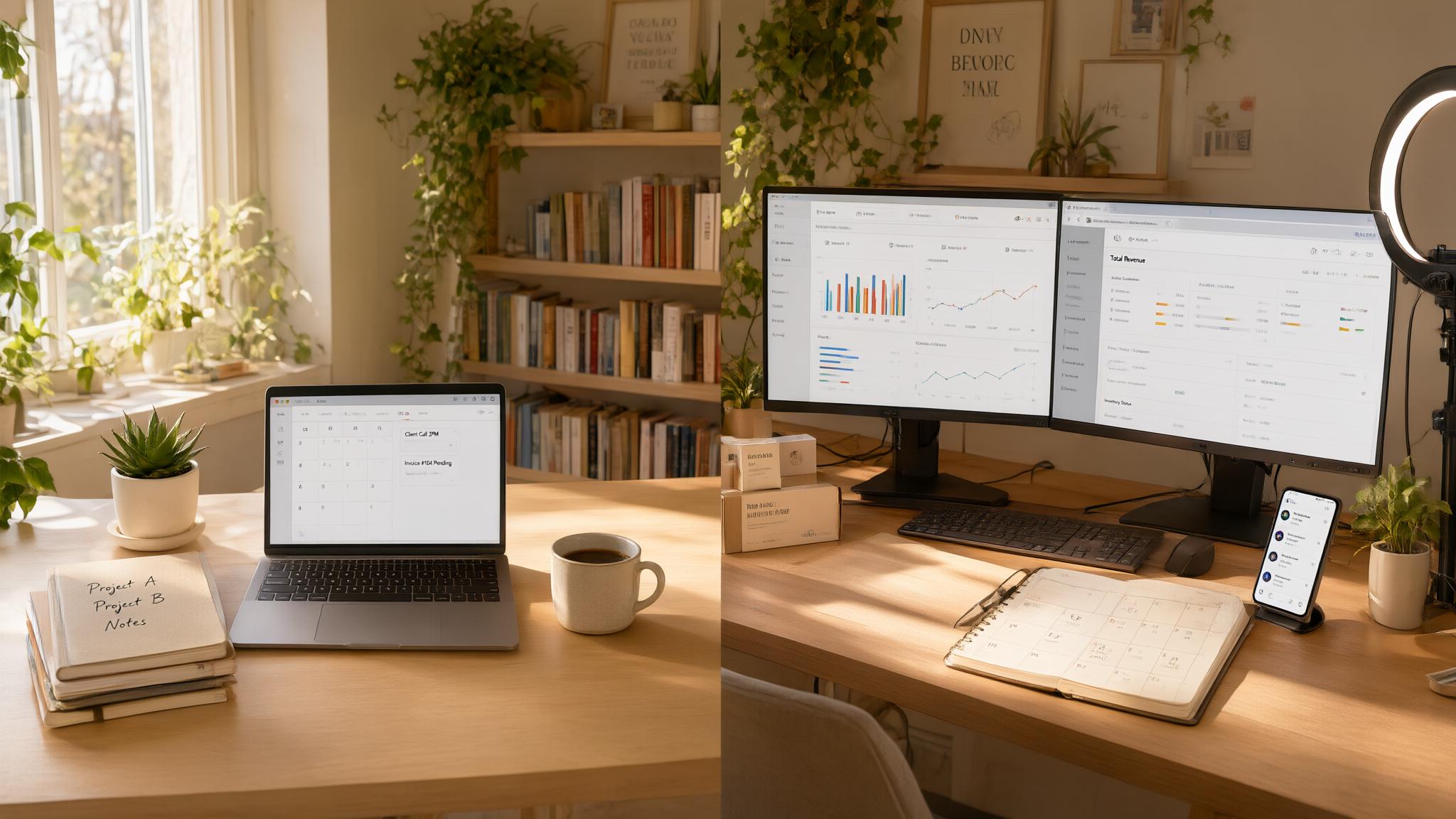
Freelancing vs starting an online business — I get asked about this constantly, and honestly, I think most of the advice out there gets it wrong by treating them as equally valid choices for every person. They’re not. After years of doing both — first as a freelance SEO consultant, then building a productized business with passive income layers — I can tell you they feel completely different to live inside of, not just on a spreadsheet.
The freedom pitch is the same for both paths, and that’s where people get confused. Yes, you ditch the boss either way. But freelancing means you are the product, while building an online business means you’re eventually trying to step back from being the product. That distinction sounds small until you’re three years in and realize you’ve either built a client dependency machine or an actual asset.
I’m not here to tell you one is better in some universal sense. I’m here to give you the unfiltered version of what each path actually demands — so you can stop romanticizing the wrong one and start making a decision that fits your real life, risk appetite, and where you want to be in five years.
What Freelancing Actually Looks Like Once the Honeymoon Ends

I’ll be honest with you — the first few months of freelancing felt like the best decision I’d ever made. No boss, no commute, work in my pajamas, pick my own clients. But somewhere around month four or five, the cracks started showing. The reality of freelancing is that you’re not really running a business — you’re renting out your time, and the moment you stop working, the money stops too. That’s the part nobody puts in the Instagram caption. When I started seriously weighing up freelancing vs starting an online business, I realized freelancing had handed me freedom in some ways and quietly taken it away in others.
The income instability is the thing that grinds you down over time. You land a great client, everything feels solid, and then they pause the project or their budget gets cut or they just ghost you — and suddenly you’re hustling hard to fill the gap again. There’s also the uncomfortable truth that your earnings are essentially capped. You can raise your rates, sure, but there are only so many hours in a day. As a freelancer vs entrepreneur comparison goes, the freelancer is almost always trading hours for euros in a way that the business owner eventually isn’t. That ceiling starts to feel very real once you’re two or three years in and you’re working more hours than you did in your old job, just for yourself instead of a company.
What I didn’t expect was how much of my time would go toward things that had nothing to do with my actual skill set — chasing invoices, writing proposals, managing client expectations, re-explaining my process for the hundredth time. The solopreneur path sounds glamorous but it’s genuinely exhausting when every single function of the business sits on your shoulders. I’m not saying freelancing is the wrong choice — for a lot of people in certain seasons of life, it’s genuinely the right one. But if you’re romanticizing it without understanding what the day-to-day actually demands, you’ll hit a wall faster than you think.
Building an Online Business: The Upside, the Grind, and the Gap Nobody Talks About

Let me be honest with you: building an online business feels nothing like the Instagram reels make it look. I spent a solid eighteen months convinced I was “just around the corner” from passive income before I finally understood what the freelancer vs entrepreneur distinction actually means in practice. When you’re weighing up freelancing vs starting an online business, the upside of the business route is real — you’re building something with leverage. You create a course, a membership, a productized service, or a digital tool, and theoretically it works while you sleep. That ceiling that haunts every freelancer — the one where more income means more hours — doesn’t exist in the same way. You can serve a hundred customers with the same asset you built once. That’s genuinely exciting, and I won’t pretend otherwise.
But here’s the gap nobody in the solopreneur space talks about with any real honesty: the time between starting and earning is brutal, and it’s almost always longer than any creator or coach will tell you upfront. You’re not just doing the work — you’re building an audience, testing offers, figuring out distribution, learning paid ads or SEO or both, and absorbing failure after failure while your bank account has opinions about all of it. Unlike freelancing, where you can land a client in week two and get paid in week four, an online business can burn through six, twelve, even eighteen months before it generates consistent revenue. I’ve lived that. It’s not a scare tactic — it’s just the actual shape of the path.
That said, the online business pros cons calculation looks very different depending on where you’re starting from. If you have savings, a spouse with income, or an existing audience, the runway feels manageable. If you’re starting from zero with real financial pressure, it’s a different conversation entirely. The solopreneur path rewards patience and systems thinking in a way that pure freelancing doesn’t require — and that’s not a flaw, it’s just the trade-off. Know what you’re signing up for before you romanticize the destination.
How to Actually Decide Which Path Is Right for You Right Now
Here’s the honest truth I wish someone had told me earlier: the freelancer vs entrepreneur debate isn’t really about which model is objectively better. It’s about where you are right now — your financial runway, your risk tolerance, and frankly, how much ambiguity you can stomach on a Tuesday afternoon when nothing is going according to plan. When I was weighing up freelancing vs starting an online business, I kept looking for a definitive answer online, and all I found were listicles telling me both options were great. Useless. What actually helped was asking myself one brutally honest question: do I need income in the next 90 days, or do I have the cushion to build something that might not pay off for 12 months?
If you need money soon and you have a marketable skill — writing, design, development, consulting, whatever — freelancing is almost always the smarter starting move. Not because it’s safer or more prestigious, but because the feedback loop is tight and fast. You pitch, you work, you get paid, you learn what the market actually values. That real-world calibration is genuinely priceless when you’re figuring out the solopreneur path for the first time. A lot of people I know who skipped this phase and jumped straight into building a product or a course ended up solving a problem nobody actually had. The freelancer vs entrepreneur distinction matters less than people think at the beginning — most solid online business owners I respect started by selling their time first.
On the other hand, if you’ve already been freelancing for a while and you’re hitting a ceiling — whether that’s income, energy, or just the creeping dread that comes with trading hours for money indefinitely — then the online business pros and cons conversation becomes genuinely worth having. That ceiling is often the signal, not the obstacle. The real question isn’t which path sounds more appealing in theory. It’s which one solves the actual problem you’re facing today, with the resources you actually have, not the ones you’re hoping to have someday.
Final Thoughts
I’ve been down both roads, and I’ll be honest — there’s no universally right answer in the freelancing vs starting online business debate. What worked for me might completely drain you, and what excites you might have bored me to tears. The real question was never about income potential or flexibility statistics. It was about knowing myself well enough to stop chasing someone else’s version of success. When I finally got honest about how I work, what risks I could stomach, and what kind of freedom I actually wanted, the right path became obvious.
So before you jump in either direction, sit with the uncomfortable questions. Do you want clients or customers? Stability or scalability? A job you own or a machine that runs without you? Both paths can lead to real freedom — but only if you choose the one that matches who you actually are, not who you think you should be.
What’s your take on this? I’d love to hear it. 👇