
Ready to streamline your marketing management without the overwhelm? This 5-step framework turns chaos into a clear marketing plan—complete with a free template, a plug-and-play content calendar, and measurable KPIs to track what actually moves the needle. Perfect for entrepreneurs and teams building a focused marketing strategy. Grab your favorite marketing planner (or project management notebook), tidy the desk organizer, and let’s map campaigns that convert—no fluff, just results. Save this for your next planning sprint and watch your brand grow, one smart step at a time.
Step 1: Audit Current Performance and Set SMART KPIs

Before we rush into tactics, take a breath and make space—literally and figuratively. Clear a corner of your desk, pop your laptop on a sturdy laptop stand, slide on those blue light glasses, and open your marketing planner alongside a trusty project management notebook. A tidy desk organizer helps, too, because Step 1 in thoughtful marketing management is an audit that feels calm, focused, and honest. Pull the last 3–12 months of data from your website, social channels, email platform, and ad accounts. Note traffic sources, conversion rates, campaign ROI, list growth, engagement, and any seasonal spikes. Scan your content library and content calendar: Where were you most consistent? What formats or topics actually moved the needle? Which posts or emails sparked saves, replies, purchases, or demos? Mark the gaps—underused channels, neglected audiences, or funnel stages missing love.
Now translate those findings into a clear baseline. Think of this as your before photo for the marketing plan: average monthly sessions, current conversion rate, cost per acquisition, customer lifetime value, email click-through, social reach, and lead volume by source. Group performance by campaign and by audience segment so you can see which combinations sing together. If your marketing strategy leans on organic content, connect top-performing posts to downstream outcomes—did they grow your list, increase qualified leads, or shorten sales cycles? If paid is your engine, examine frequency, creative fatigue, and how well landing pages carry the message.
With the truth on the table, set SMART KPIs—specific, measurable, achievable, relevant, and time-bound—that directly ladder up to revenue goals. For example: increase qualified leads from organic search by 25% in Q2; lift email click rate from 2.1% to 3.5% within 60 days by testing two new CTAs; reduce paid social CPA by 15% by tightening audience and refreshing creative this month; publish eight SEO-backed blog posts and two lead magnets that feed your content calendar by quarter’s end. Assign an owner, a data source, and a check-in cadence for each KPI, then drop them into your marketing plan and weekly dashboard. Keep them visible—pinned above your desk, tucked inside your planner, or front-and-center in your notebook—so your daily to-dos line up neatly with the bigger marketing strategy you’re building.
Step 3: Turn Strategy into a Measurable Marketing Plan and Budget
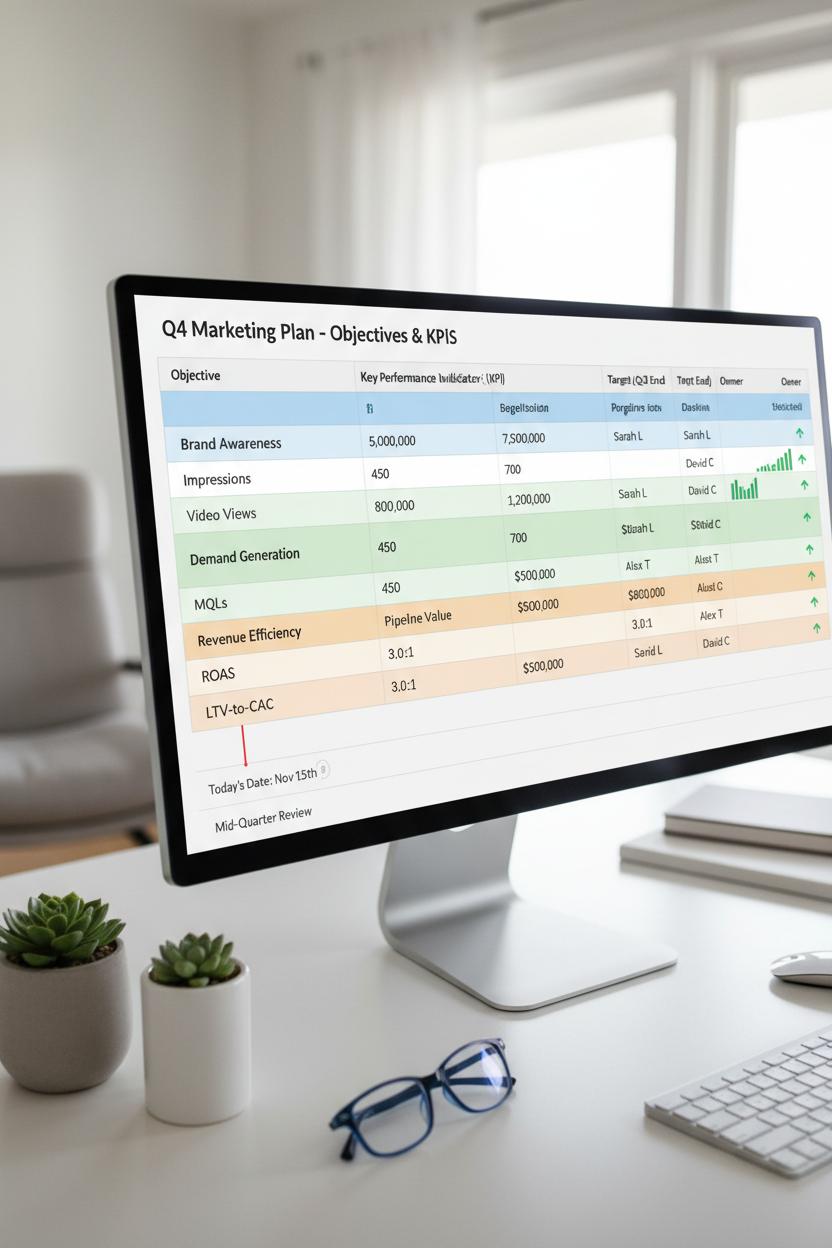
Now it’s time to take that shiny marketing strategy and give it dates, dollars, and owners. Think of this step as laying out a cozy-but-crisp roadmap: you’re turning vision into a measurable marketing plan with a budget you can actually track. Start by translating each objective into one or two clear KPIs—make them specific and time-bound. If your goal is brand awareness, choose impressions, reach, or video views. If it’s demand, look at MQLs, pipeline value, conversion rate, and CAC. For revenue efficiency, consider ROAS, LTV-to-CAC, and payback period. Attach a baseline and a target to each so marketing management becomes less guessy and more “we know what winning looks like.”
Next, map initiatives to a content calendar. Plot campaigns, launches, and seasonal moments, then layer in channel tasks—emails, reels, blog posts, ads, partnerships—so you can see the storytelling arc at a glance. Assign owners and due dates, and add production checkpoints like briefs, creative reviews, and UTM setup. If you’re a pen-and-paper person, a marketing planner or a simple project management notebook can be magic; if you’re digital, mirror the same structure in your tool so the calendar and task views tell the same story. Color-code by funnel stage, and give every task a KPI tag so measurement is never an afterthought.
For budget, choose a simple allocation model you can maintain. Many teams use a 70-20-10 split: 70% to proven channels, 20% to scalable tests, 10% to big swings. Document fixed costs (software, freelancers, retainers) and variable costs (media, creators, printing), then tie each line to an initiative and its KPI. Set monthly guardrails with a “pause or double-down” rule based on performance thresholds, and schedule a standing review to rebalance. Your marketing plan should also include a lightweight reporting cadence: weekly pulse (leading indicators), monthly rollup (KPI progress vs. target), and quarterly retro (what to stop, start, scale).
Create a workspace that invites consistency: pop your laptop on a comfortable laptop stand, corral pens and sticky notes in a desk organizer, and keep your blue light glasses nearby for those late creative sprints. When your tools and timelines are calm and clear, marketing management feels less like juggling and more like crafting results on purpose.
Conclusion
And that’s your 5-step marketing management framework, tied with a bow. Save the free template, map your marketing strategy, and build a content calendar you’ll actually follow. Set clear KPIs, review them weekly, and let the numbers guide your next move. Keep your marketing plan simple: one audience, one goal, one message at a time. Light a candle, pour a coffee, and spend 30 focused minutes each day—plan, create, measure, repeat. Small, consistent steps turn ideas into impact. You’ve got this—and your best campaign yet.